How did the tiny screw end up becoming a celebrated design motif on watches?
Advertisement
Obsessions
How did the tiny screw stop up becoming a celebrated design motif on watches?
Bezel screws were never meant as decoration. On the earliest wristwatches, they were functional, securing the glass to the instance. Today, however, they have become desirable features, vaunted by watchmakers and sentry enthusiasts alike.
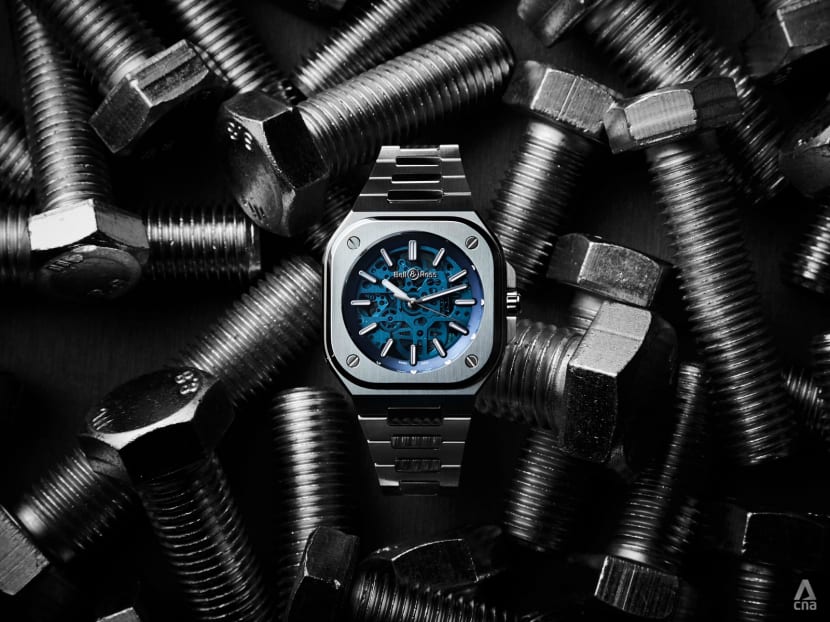
Bong & Ross'southward Skeleton Bluish BR 05 is the latest in the long line of watches to characteristic screws on the bezel. (Photo: Aik Chen/Fine art: Jasper Loh)
06 Aug 2022 06:30AM (Updated: 07 Sep 2022 10:20AM)
Broadly speaking, screws are the i matter designers and engineers try to keep out of sight. Whether information technology's article of furniture, gadgets or appliances, an exposed screw implies unfinished work and lazy craftsmanship.
And for the most part, they're just non very pretty to look at – except when they're on watches. In that location are of course instances where the humble component is part of an overall design language or even highlighted every bit a motif, but this is specially celebrated in fine watchmaking.
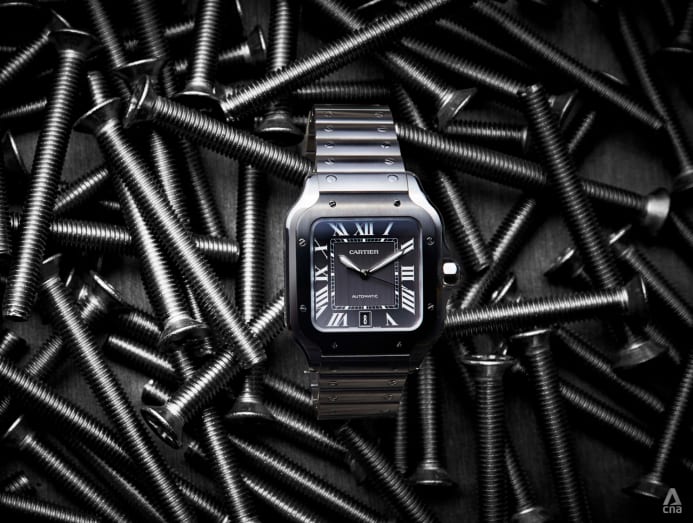
Only while they look cool now, bezel screws were never purely decorative. The earliest example would take to exist Cartier'southward Santos, since it is widely believed to exist the first men's (and airplane pilot's) wristwatch e'er made.
Created in 1904 by Louis Cartier for the Brazilian aviator Alberto Santos-Dumont, the foursquare-faced watch used 8 screws to secure the drinking glass to the watch and were left on display – a nod to all the steel structures (like the Eiffel Tower) that were being built in Paris at the fourth dimension. As the Art Deco style became increasingly popular, the screw size and bezel of the Santos grew to friction match.
Only this design feature didn't explode until Audemars Piguet'south rebellious Imperial Oak took off. Legendary watch designer Gerald Genta, who had past then made a name for himself past designing the SAS Polerouter and giving Omega its Constellation, was tasked to come up upward with a design that would save Audemars Piguet's slump season in 1970. Genta's inspiration came from old diving helmets, and their mesomorphic gaskets were what gave ascent to the octagonal example with its eight gold screws.
Bolstered by the demand for the Royal Oak, Genta carried the look over to IWC 6 years later, who needed his assistance reinventing the Ingenieur. What was once an unmemorable round watch became the circle-in-tonneau example we know and honey today, held together by v distinct screws.
These industrial-chic bezels had become so in vogue that it galvanised two brands into releasing similar products. When Carlo Crocco founded Hublot in 1980, his get-go lookout man resembled a send's porthole, which is where Hublot, French for "porthole", got its name.

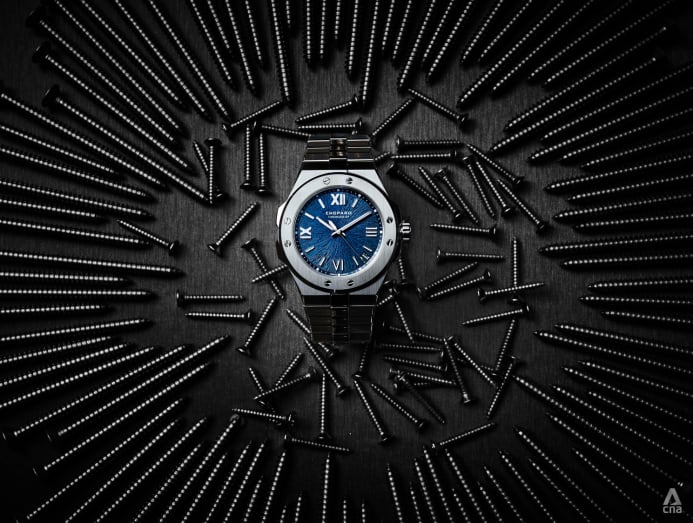
That aforementioned year Chopard released the St Moritz, its first steel sentinel. Interestingly, both vintage models ended upwardly being reborn decades later as the Hublot Big Blindside and the Chopard Tall Eagle respectively.
Not all watchmakers were trying to follow in Genta'due south footsteps. In 2005, Bong & Ross released the now iconic BR 01, giving the brand a much-needed stylistic identity. The round punch, square case, screws in the corners and prominent indices were influenced past vintage dashboard instruments in military planes, where things similar the artful value of exposed nuts and bolts were patently non priorities.
That militaristic look has served Bell & Ross well, but its latest collection proves that the almighty bezel screw can go a long way in maintaining i'southward blueprint Deoxyribonucleic acid. Released in 2019, the all-steel BR 05 drove is a softer, more elegant take on the brand'southward typically rugged offerings thanks to a number of changes.
The overall shape is now a rounded square with a bezel to lucifer, the directly lugs from the BR 01 and BR 03 have been swapped to a centre link that leads into a bracelet or strap. New crown guards add together to the streamlined form. Just Bell & Ross kept what matters: The typeface, shape and, of course, the screws. And more chiefly to some: aligned screws.
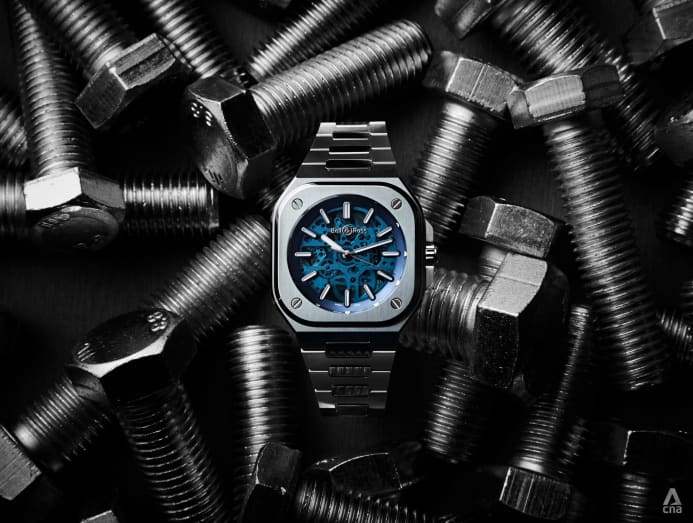
Considering the only thing more talked about than the trendiness of visible screws is the alignment of said screws. In the Bell & Ross BR 05 and BR 03 models, the screws are placed at a pleasingly precise 45 degree angle. This isn't always true for such cases – look closely at your Santos or Large Bang and y'all'll realise their screws point every which way. (And if you lot've never noticed before at present, we're sorry.)
There's a flim-flam to it that Audemars Piguet also employs for its Royal Oak. Those screws nosotros see are really bolts that fit perfectly into the slots created for them, and are secured by screws found on the case back, and those don't line upwardly.
It is technically possible to create screws with threads that start and end in the exact same orientation while also making certain the countersinks all accept identical depths, but the additional fourth dimension and try to do all that – known every bit "timing" the screws – would ship prices (further) into the heavens.
Not to mention screws that are specially reworked to be perfectly aligned are no longer interchangeable with other slots, which ways even more than work when it comes time to service the watch.
Timing screws seems to be the domain of luxury shotgun makers and obsessive-compulsive carpenters, merely those who idly wish horologers would adopt this practise take to deal with the implication that watches with exposed screws volition simply become rarer and more than expensive. And tin can you imagine Cartier having to align every single one of its screws on the Santos' bracelet?
Let's just capeesh the screw for what it is: An essential, normally invisible part of watchmaking that happens to look pretty neat when given its day in the sun.
READ> If you thought the luxury smartwatch was a one-off gimmick, call back again

Contempo Searches
Trending Topics
Source: https://cnalifestyle.channelnewsasia.com/obsessions/screw-motif-on-watches-247616
0 Response to "How did the tiny screw end up becoming a celebrated design motif on watches?"
Post a Comment