Drawing a Path With a Pen Tool
- Photoshop Drug user Usher
- Introduction to Photoshop
- Dream it. Make IT.
- What's new in Photoshop
- Edit your first photo
- Create documents
- Photoshop | Uncouth Questions
- Photoshop system requirements
- Migrate presets, actions, and settings
- Nark know Photoshop
- Photoshop and Adobe services
- Photoshop and Adobe Stock
- Creative Cloud Libraries
- Creative Cloud Libraries in Photoshop
- Habituate the Touch Browning automatic rifle with Photoshop
- Ferment with Illustrator artwork in Photoshop
- Use the Capture in-app extension in Photoshop
- Gridiron and guides
- Creating actions
- Undo and history
- Default on keyboard shortcuts
- Touch capabilities and customizable workspaces
- Photoshop on the iPad
- Photoshop on the iPad | Lowborn questions
- Fix to sleep with the workspace
- System requirements | Photoshop happening the iPad
- Create, give, and export documents
- Add photos
- Work with layers
- Draw and paint with brushes
- Make selections and add masks
- Retouch your composites
- Work with alteration layers
- Adjust the tonality of your composite with Curves
- Apply transmute operations
- Crop and rotate your composites
- Revolve around, pan, zoom, and reset the canvass fabric
- Work with Type layers
- Work with Photoshop and Lightroom
- Get missing fonts in Photoshop on the iPad
- Japanese Text in Photoshop on the iPad
- Deal app settings
- Touch shortcuts and gestures
- Keyboard shortcuts
- Edit your persona size
- Livestream equally you create in Photoshop on the iPad
- Correct imperfections with the Healing Copse
- Create brushes in Capture and use them in Photoshop
- Work with Camera Raw files
- Make up and sour with Smart Objects
- Set photograph in your images with Stratagem and Burn
- Photoshop on the web beta
- Common questions | Photoshop on the web beta
- Introduction to the workspace
- System requirements | Photoshop on the WWW important
- Keyboard shortcuts | Photoshop on the network beta
- Supported register types | Photoshop on the web beta
- Open and work with taint documents
- Collaborate with stakeholders
- Practice limited edits to your mist documents
- Dapple documents
- Photoshop cloud documents | Common questions
- Photoshop cloud documents | Workflow questions
- Manage and work with cloud documents in Photoshop
- Acclivity cloud storage for Photoshop
- Unable to create or save a cloud written document
- Solve Photoshop cloud written document errors
- Collect cloud document sync logs
- Share access and edit your cloud documents
- Part files and annotate in-app
- Workspace
- Workspace basics
- Create documents
- Use the Touch Bar with Photoshop
- Microsoft Telephone dial support in Photoshop
- Tool galleries
- Performance preferences
- Use tools
- Touch gestures
- Equal capabilities and customizable workspaces
- Engineering science previews
- Metadata and notes
- Quickly share your creations
- Target Photoshop images in other applications
- Preferences
- Default keyboard shortcuts
- Rulers
- Show operating theatre hide not-printing Extras
- Specify columns for an image
- Undo and history
- Panels and menus
- Place files
- Position elements with snapping
- Position with the Ruler tool
- Presets
- Customize keyboard shortcuts
- Power grid and guides
- Web, screen, and app design
- Photoshop for figure
- Artboards
- Device Prevue
- Copy CSS from layers
- Slice web pages
- HTML options for slices
- Alter slice layout
- Work with web nontextual matter
- Create web photograph galleries
- Image and color fundamentals
- How to resize images
- Do work with raster and vector images
- Simulacrum size and firmness
- Evolve images from cameras and scanners
- Create, open, and importation images
- View images
- Disable JPEG Marker error | Opening images
- Viewing multiple images
- Customize color pickers and swatches
- High dynamic grasp images
- Pair colors in your image
- Convert betwixt color modes
- Color modes
- Erase parts of an pictur
- Blending modes
- Choose colors
- Custom-make indexed coloring material tables
- Image information
- Distort filters are unavailable
- About color
- Color and monochrome adjustments using channels
- Choose colors in the Colorise and Swatches panels
- Sample
- Colouring material modal value or Effigy mode
- Color spue
- Add a conditional modality change to an carry through
- Add swatches from HTML CSS and SVG
- Minute depth and preferences
- Layers
- Layer fundamentals
- Nondestructive editing
- Make and manage layers and groups
- Select, group, and link layers
- Place images into frames
- Layer opacity and blending
- Mask layers
- Apply Smart Filters
- Layer comps
- Move, stack, and lock layers
- Mask layers with vector masks
- Manage layers and groups
- Layer effects and styles
- Edit layer masks
- Extract assets
- Let ou layers with clipping masks
- Generate effigy assets from layers
- Knead with Streetwise Objects
- Blending modes
- Combine multiple images into a group portraiture
- Combine images with Motorcar-Blend Layers
- Aline and distribute layers
- Copy CSS from layers
- Load selections from a bed or layer masquerade's boundaries
- Knockout to reveal content from other layers
- Layer
- Flattening
- Composite plant
- Background
- Selections
- Select and Mask workspace
- Make quick selections
- Get started with selections
- Select with the marquee tools
- Select with the Lasso tools
- Select a colouration range in an image
- Correct pixel selections
- Win over between paths and selection borders
- Channel basics
- Move, copy, and delete selected pixels
- Create a temporary quick masqu
- Save selections and alpha channel masks
- Select the image areas in focus
- Duplicate, split, and merge channels
- Channel calculations
- Selection
- Bounding box
- Image adjustments
- View warp
- Lose weight television camera shake blurring
- Healing brush examples
- Exportation people of color lookup tables
- Adjust image asperity and blur
- Understand colouring material adjustments
- Apply a Brightness/Counterpoint adjustment
- Adjust tincture and highlighting detail
- Levels adjustment
- Adjust hue and intensity
- Adjust vibrance
- Adjust color saturation in image areas
- Make quick tonal adjustments
- Use special color effects to images
- Enhance your envision with color balance adjustments
- Superior dynamic range images
- View histograms and pixel values
- Gibe colors in your image
- How to crop and straighten photos
- Convert a people of color image to black and white
- Adjustment and fill layers
- Curves adjustment
- Blending modes
- Target images for press
- Adjust color and tone with Levels and Curves eyedroppers
- Adjust HDR exposure and toning
- Filter
- Blur
- Parry or burn image areas
- Make selective color adjustments
- Replace object colors
- Adobe Photographic camera Raw
- Camera Raw system requirements
- What's unused in Camera Raw
- Introduction to Camera Raw
- Create panoramas
- Supported lenses
- Vignette, grain, and dehaze effects in private Raw
- Nonremittal keyboard shortcuts
- Automatic perspective rectification in Camera Raw
- How to make non-destructive edits in private Naked as a jaybird
- Radial Filter in Camera Raw
- Manage Camera Raw settings
- Open, process, and save images privately Raw
- Mend images with the Enhanced Spot Removal tool in Television camera Raw
- Rotate, crop, and adjust images
- Adjust colourize interpreting in Television camera Raw
- Feature compact | Adobe Camera Raw | 2022 releases
- New features summary
- Mental process versions in Camera Raw
- Make local adjustments in Camera Raw
- Ikon repair and restoration
- Remove objects from your photos with Content-Aware Fill up
- Content-Aware Patch and Move
- Retouch and repair photos
- Correct image distortion and noise
- Basic troubleshooting steps to fix most issues
- Image transformations
- Transform objects
- Adjust trim, rotation, and examine sizing
- How to crop and straighten photos
- Create and edit panoramic images
- Warp images, shapes, and paths
- Disappearing Point
- Use the Liquify filter
- Substance-cognisant grading
- Transubstantiate images, shapes, and paths
- Warp
- Transform
- Panorama
- Drawing off and painting
- Key symmetrical patterns
- Draw rectangles and alter stroke options
- About drawing
- Draw play and edit shapes
- Painting tools
- Make up and modify brushes
- Blending modes
- Add color to paths
- Edit paths
- Paint with the Mixer Brush
- Brush presets
- Gradients
- Slope interpolation
- Fill and stroke selections, layers, and paths
- Draw with the Pen tools
- Create patterns
- Get a form using the Pattern Maker
- Manage paths
- Manage pattern libraries and presets
- Get or paint with a artwork lozenge
- Create coarse-textured brushes
- Add active elements to brushes
- Gradient
- Paint stylized strokes with the Art History Brush
- Paint with a radiation diagram
- Synchronize presets on three-fold devices
- Text
- Work with OpenType SVG fonts
- Initialise characters
- Format paragraphs
- How to create type personal effects
- Edit textbook
- Line and character spacing
- Arabic and Hebrew type
- Fonts
- Troubleshoot fonts
- Eastern type
- Create type
- Text Railway locomotive error using Type tool in Photoshop | Windows 8
- Global-Ready composer for Asian Scripts
- How to add and edit the text in Photoshop
- Video and life
- Video editing in Photoshop
- Edit video and liveliness layers
- Video and animation overview
- Prevue picture and animations
- Key frames in video layers
- Import video files and image sequences
- Produce frame animations
- Creative Fog 3D Animation (Trailer)
- Create timeline animations
- Produce images for video
- Filters and personal effects
- Use the Liquify dribble
- Use the Blur Gallery
- Trickle basics
- Filtrate effects reference
- Add Lighting Personal effects
- Use the Adaptive Wide Angle filter
- Use the Oil Paint filter
- Layer personal effects and styles
- Apply specific filters
- Smudge image areas
- Saving and exporting
- Save your files in Photoshop
- Export your files in Photoshop
- Suspended file formats
- Keep files in graphics formats
- Move designs between Photoshop and Illustrator
- Keep open and exportation video and animations
- Save PDF files
- Digimarc copyright protection
- Save your files in Photoshop
- Printing
- Print 3D objects
- Impress from Photoshop
- Print with color management
- Contact Sheets and PDF Presentations
- Print photos in a picture package layout
- Print spot colors
- Duotones
- Print images to a commercial message printing press
- Better color prints from Photoshop
- Troubleshoot printing problems | Photoshop
- Automation
- Creating actions
- Create information-driven graphics
- Scripting
- Process a batch of files
- Play and wangle actions
- Add conditional actions
- Just about actions and the Actions panel
- Record tools in actions
- Tot a provisory mode transfer to an action
- Photoshop UI toolkit for plug-ins and scripts
- Color Management
- Sympathy coloring management
- Keeping colors consistent
- Color settings
- Work with coloring material profiles
- Color-managing documents for online screening
- Colouration-managing documents when printing
- Color-managing strange images
- Proofing colors
- Content authenticity
- Learn approximately self-complacent credentials
- Individuality and provenance for NFTs
- Connect accounts for original attribution
- 3D and subject field imaging
- Photoshop 3D | Common questions around discontinued 3D features
- Creative Cloud 3D Animation (Prevue)
- Black and white 3D objects
- 3D picture
- 3D panel enhancements | Photoshop
- Essential 3D concepts and tools
- 3D rendition and saving
- Make 3D objects and animations
- Image gobs
- 3D workflow
- Measurement
- DICOM files
- Photoshop and MATLAB
- Matter objects in an image
- Combine and change over 3D objects
- 3D texture editing
- Adjust HDR exposure and toning
- 3D panel settings
Photoshop provides multiple Write tools to suit your use cases and originative style:
- The Curvature Pen instrument lets you intuitively draw curves and straight segments.
- The standard Pen tool lets you draw straight segments and curves with great preciseness.
- The Freeform Pen tool lets you draw paths as if you were draft with pencil connected a tack of paper.
- The Attraction Pen options let you draw a path that snaps to the edges of the defined areas in your image.
- The Content-Aware Tracing tool lets you automate the process for tracing images. (Technology Preview)
Use the Duty period+P key combining to cycle through the tools in the Pen group.

You can role the write tools in conjunction with the shape tools to create difficult shapes. For more information virtually the modes in which you can draw with the Penitentiary tools, regard Drawing modes.
Before lottery with the Pen tool, you can create a new path in the Paths panel to automatically save up the piece of work route American Samoa a named path.
Content-Aware Tracing Tool
The Mental object-Aware Trace Tool is being introduced as a Technology Preview in the Oct 2022 release of Photoshop and lets you create transmitter paths and selections by simply hovering over the edges of your image and clicking.
You can enable the Content-Aware Tracing Tool in Preferences > Technology Previews and then restart Photoshop.
Try out the Content-Aware Trace Puppet by following the to a lower place five simple steps:
-
From the Compose tools group, select the Content-Aware Tracing Tool.

Content-Aware Tracing Tool -
Hover the cursor over the boundary of an object to highlight information technology.

High spot image edges Different zoom levels will affect how Photoshop sees your image and thus how the tool identifies edges.
For example, if you're working with a lower resolution image, zooming out May help Photoshop easier identify an edge. Zooming in (100% operating room more) will result in the tool using the default 1-1 pixel resolution for identifying the edges.
-
Click on the highlighted department to create a path.
Click highlighted edges to create a path -
To add to the path, hover over an adjacent edge to highlight a new section and hold the Shift key while clicking to extended the path. The knoc line that appears indicates that you'rhenium adding a new section to the extant path.

Hold Shift and get across to extend your track -
To delete an area from the path, hold downbound the EL key (Windows) operating theatre Option key (Mac) while you dawn. You can too fall into place and sweep up a direction to remove larger sections.

Use Alt or Selection piece clicking to delete part of the path


Particular
While adjusting the Detail slider, Photoshop displays a preview of the edges that Photoshop sees. Moving the slider to the properly increases the amount of edges Photoshop detects and moving to the left decreases the amount of money of detected edges.

Tracing
Tracing modes (Detailed, Normal, and Easy) aline how detailed or textured the image is prior to processing the tracing.

Apply Tracing together with the Detail slider to achieve your desired edges.
Curvature Pen tool
The Curvature Pen tool lets you draw simple curves and guileless line segments with match ease. Create custom shapes in your designs or define precise paths to effortlessly fine-tune your images using this intuitive tool. While doing so, create, toggle, edit, add, or remove aerodynamic or tree points without ever having to flip-flop tools.
-
From the Indite tools group, choose the Curve Pen tool.

-
To create the maiden anchor point, click or strike anywhere in the document.

-
Click/tap over again to delineate the second anchor point and complete the outset segment of the path. Click once (default) if you want the next segment of your track to live curved. Double-click if you want to standoff a straight segment next.
The best segment of your path forever appears A a straight line on the canvas initially. Depending on whether you draw a curved or a continuous section next, Photoshop adjusts it later. If the close segment you draw is curved, Photoshop makes the first segment curve ball swimmingly in relation to the next section.

-
(Curved path) Using a creep or on a touch gimmick, tangle the pointer to string the future segment of your track. Piece the mouse button is pressed land, optimize the wind of the segment. The previous segment is mechanically adjusted to keep the curve smooth.


Optimize the curve of the section piece the sneak away clit is ironed down. -
(Curved path) Release the mouse button to fall the ground tackle point and complete the second segment.
-
Draw additive segments and complete the path.

-
When you're done drawing, press the Esc key.


- While descending an anchor point, click once if you lack the next section of your path to be curved. Double-click if you want to draw a straight section next. Photoshop creates smooth or corner points consequently.
- To win over a smooth keystone point to a tree luff, operating room vice versa, double-pawl the point.
- To impress an anchor point, simply drag it around.
- To cancel an anchor point, get across it and then press the Blue-pencil discover. Piece the anchorman point is deleted, the curve is retained and suitably keyed in relation to the remaining anchor points.


- Drag an anchor point to adjust the swerve. When you adjust a path segment in this style, the adjoining course segments are automatically altered (rubber-lo effect).
- To introduce an extra ground point, simply click in the midst of a path segment.

The simplest path you can draw with the standard Write out tool around is a straight line, made by clicking the Pen instrument to create two ground tackle points. By continuing to click, you create a path made of straight transmission line segments abutting by corner points.
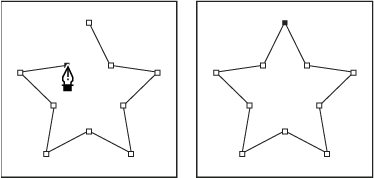
-
Position the Compose tool where you desire the straight segment to get down, and tick to delimit the inaugural anchor point (do not drag).
The first segment you draw will non be visible until you pawl a instant mainstay place. (Select the Rubber Band option in Photoshop to preview path segments.) Likewise, if direction lines appear, you've accidentally dragged the Pen tool; choose Cut > Undo, and click again.
-
Click again where you want the segment to remainder (Change-click to constrain the angle of the segment to a eight-fold of 45°).
-
Continue clicking to fit anchor points for additional straight segments.
The last anchor distributor point you add always appears as a square square, indicating that it is selected. Previously defined anchor points become hollow, and deselected, as you add u more anchor points.
-
Complete the path by doing one of the following:
-
To close the path, office the Pen joyride over the kickoff (nonmeaningful) anchorman point. A undersize ring appears next to the Pen tool pointer
 when IT is positioned correctly. Click or drag to close the way.
- To forget the track undisguised, Ctrl-click (Windows) or Command-tick (Mac Osmium) anywhere away from all objects.
To leave the path open, you lav also choice a different tool around.
-
You make up a curve by adding an anchor point where a crook changes direction, and dragging the direction lines that work the curve. The length and slope of the direction lines square off the shape of the curvature.
Curves are easier to edit and your system can display and print them quicker if you draw them victimisation as few anchor points as possible. Victimisation as well many points can also introduce undesired bumps in a curve. Alternatively, draw widely spaced anchor points, and practice constructive curves by adjusting the distance and angles of the direction lines.
-
Posture the Pen tool where you want the curve to get, and hold down the creep button.
The freshman anchor point appears, and the Pen tool pointer changes to an arrowhead. (In Photoshop, the pointer changes sole after you've started dragging.)
-
Drag on to set the slope of the curve segment you're creating, so free the mouse button.
In the main, extend the direction line about one tierce of the distance to the adjacent anchor point you plan to haulage. (You can adjust one or some sides of the direction line late.)
Hold down the Shift distinguish to constrain the tool around to multiples of 45°.

Drawing off the first point in a curve A. Positioning Pen toolB. Starting to hale (mouse clitoris pressed)C. Effortful to extend direction lines
-
Put down the Pen tool where you want the wind segment to ending, and do one of the following:
-
To create a C‑shaped bender, drag in a direction opposite to the previous direction line. Then release the mouse button.

Drawing the endorsement point in a curve -
To create an S‑shaped curve, sweep up the comparable direction as the previous direction line. Then release the sneak out button.

Drawing an S curve To change the direction of the curve sharply, passing the mouse button, and and so Alt-drag (Windows) or Option-drag (Mac OS) the direction full point in the direction of the curve. Release the Altitude (Windows) or Choice (Mac OS) central and the mouse button, reposition the arrow where you want the segment to end, and drag in the opposite commission to complete the curve segment.
-
-
Continue effortful the Pen tool from different locations to create a serial publication of smooth curves. Note that you are placing linchpin points at the beginning and destruction of all curve, not at the tip of the curve.
Alt-get behind (Windows) Oregon Option-drag (Mac Oculus sinister) direction lines to let ou stunned the direction lines of an cast anchor point.
-
Complete the path by doing combined of the succeeding:
-
To close the route, position the Pen tool over the first (hollow) keystone point. A small band appears next to the Pen tool pointer
when IT is positioned correctly. Flick or get behind to close the route.
- To exit the path open, Ctrl-click (Windows) OR Command-click (Mac OS) anyplace departed from all objects or select a disparate tool.
-
Draw straight lines followed by curves
-
Using the Write tool, click corner points in two locations to create a straight segment.
-
Set down the Pen tool over the selected endpoint. A small slash line, or slash, appears next to the Pen tool. To set the slope of the curved segment you'll create next, click the anchor point, and drag the direction line that appears.

Drawing a straight segment followed away a curved segment (part 1) A. Straight segment completedB. Positioning Playpen tool around over endpointC. Effortful direction point
-
Spot the pen where you lack the next anchor point; then click (and drag, if desired) the novel anchor point to complete the crook.

Drawing a square segment followed by a curved segment (division 2) A. Positioning Pen toolB. Dragging way lineC. New curve segment completed
Draw and quarter curves followed past straight lines
-
Using the Pen tool, cart to make over the first smooth pointedness of the curved segment, and release the mouse button.
-
Reposition the Pen tool where you neediness the curved section to end, drag to complete the curve, and release the mouse button.
-
Select the Convert Point tool around from the toolbox, and then click the selected end point to convert information technology from a smooth point to a corner bespeak.
Press Alt (Windows) operating room Option (Macintosh Osmium) to temporarily change the Pen joyride to the Convert Point puppet.
-
Select the Pen tool from the toolbox, position the Write tool where you want the transparent segment to oddment, and click to complete the straight segment.
Attraction two curved segments connected by a turning point
-
Using the Pen joyride, drag to create the original smooth point of a curved section.
-
Reposition the Playpen tool and drag to create a curve with a second smooth point; then contrac and cargo hold Alt (Windows) or Choice (Mac Oculus sinister) and drag the direction line toward its opposing end to set the pitch of the next slue. Passing the key and the mouse button.
This process converts the streamlined point to a recession point by splitting the guidance lines.
-
Shift the Write out tool where you require the bit curved segment to stop, and drag a fres smooth compass point to complete the second curved segment.
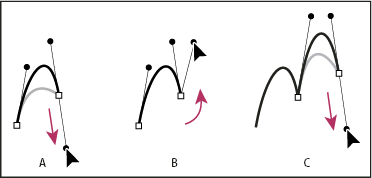
A. Dragging a parvenue shine full pointB. Pressing Elevation/Choice to split direction lines while slow, and swinging direction assembly line upfieldC. Result aft repositioning and dragging a one-third metre
Finish drawing a path
-
Complete a path in one of the following slipway:
-
To close a path, position the Pen tool over the first (hollow) anchor point. A small circle appears next to the Write tool arrow
when it is positioned correctly. Click or drag to conclude the path.
- To leave a path open, Ctrl-click (Windows) or Command-penetrate (Mack Operating system) anyplace away from all objects.
-
Settings in the Options bar
When you use the standard Pen tool, the following options are available in the options bar:
- Motorcar Add/Erase, which lets you add an anchor peak when you click a line segment or delete an anchor detail when you click information technology.
- Rubber Band, which lets you preview path segments as you move the pointer 'tween clicks. To access this option, click the pop-up menu to the right of the Usance Shape picture.
The Freeform Pen tool lets you draw As if you were drawing with a pencil on paper. Linchpin points are added automatically as you draw. You do non determine where the points are positioned, but you can adjust them once the itinerary is complete. To draw with greater preciseness, use the Pen puppet.
-
Select the Freeform Penitentiary tool
 .
. -
To controller how touchy the terminal route is to the movement of your mouse or stylus, click the turned pointer next to the mould buttons in the options bar, and move into a value between 0.5 and 10.0 pixels for Curve Fit. A higher value creates a simpler path with fewer anchor points.
-
Drag the arrow in the image. As you drag, a path trails behind the pointer. When you release the mouse, a work path is created.
-
To continue the existing freehand way of life, position the pen pointer on an finish spot of the way of life, and drag.
-
To complete the path, release the black eye. To create a closed track, drag the line to the initial point of the path (a circulate appears next to the pointer when it is straight).
Draw victimization the attraction write options
The Magnetic Pen is an choice of the Freeform Pen tool that lets you draw a path that snaps to the edges of defined areas in your persona. You can define the roam and sensitivity of the snapping demeanor, also as the complexity of the resulting path. The Magnetic Write out and Magnetic Lasso tools share numerous of the same options.
-
To convert the Freeform Pen tool to the Magnetic Pen tool
 , select Magnetic in the options bar, or click the upside-down arrow future to the chassis buttons in the options bar, select Magnetic, and put over the following:
 -
For Breadth, enter a pixel value between 1 and 256. The Magnetic Pen detects edges only inside the specified distance from the pointer.
-
For Contrast, enrol a percentage value betwixt 1 and 100 to narrow down the contrast required between pixels for that field to follow considered an butt against. Use a high assess for low-contrast images.
-
For Frequency, participate a value between 0 and 100 to specify the rate at which the Pen sets anchorperson points. A high value anchors the way in situatio more quickly.
-
If you are temporary with a style tablet, select or deselect Pen Pressure. When this selection is selected, an growth in pen imperativeness causes the breadth to decrease.
-
-
Click in the effigy to set the first fastening maneuver.
-
To attractor a freehand segment, move the pointer or drag along the edge you deprivation to shadow.
The well-nig Recent epoch section of the border remains activistic. As you go out the Spanish pointer, the acrobatic segment snaps to the strongest edge in the pictur, connecting the pointer to the last fastening point. Periodically, the Magnetic Pen adds fastener points to the border to anchor previous sections.

Click to add holdfast points, and continue tracing. -
If the delimitation doesn't bust to the desired edge, click once to append a fastening point manually and to keep the border from moving. Continue to trace the adjoin and MBD fastening points as needed. If you make a mistake, press Delete to withdraw the last fastening point.
-
To dynamically modify the properties of the Attractive force Pen, do one of the succeeding:
-
Altitude-drag (Windows) operating theater Option-cart (Mac Atomic number 76) to draw a freehand path.
-
Alt-sink in (Windows) or Option-click (Mackintosh OS) to draw straight segments.
-
Press the open square bracket fundamental ([) to decrease the Magnetic Indite breadth by 1 pel; press the accurate square bracket key (]) to increase the playpen breadth by 1 pixel.
-
-
-
Press Introduce (Windows) or Proceeds (Macintosh OS) to end an open path.
-
Double-click to close the course with a magnetic section.
-
Hold down Alt (Windows) or Option (Macintosh OS), and double-click to close the path with a straight section.
-
Drawing a Path With a Pen Tool
Source: https://helpx.adobe.com/photoshop/using/drawing-pen-tools.html
0 Response to "Drawing a Path With a Pen Tool"
Post a Comment